Saturday, August 28, 2021

Logging Inappropriate for Roaring Rock Park

Have you heard about the current logging underway at Roaring Rock Park, the beautiful, 400-acre wooded preserve in Washington Township, Warren County, NJ? Much has been said lately about severe environmental damage that would result if the Township’s “Forest Management Plan” (FMP) is enacted. Without stakeholder input, residents and environmental groups only recently heard about the FMP, although the project had been in development by the Township for at least five years. I initially thought it might be an opportunity to improve this woodlot. As a former Assistant Director of the NJDEP Division of Parks & Forestry and an experienced and nationally-certified parks & recreation professional serving as land manager and agency head on municipal, county and state levels for 42 years, however, I found this FMP sorely lacking.

NJ Highlands Coalition representatives and I advised the Township to limit their logging to winter months to minimize erosion and soil compaction when the soil is frozen and the vegetation is dormant. They said they would reassess the situation and wouldn’t proceed without further study. We recommended the following FMP amendments:

  1. Develop a forest restoration plan to replicate the existing eastern deciduous forest ecosystem.
  2. Develop a strategy for addressing invasive plant species, which spread to fill in the holes after the trees fall. 
  3. Develop a deer management plan, as deer will decimate any native seedlings that manage to grow in those opened areas.

A robust, fully funded restoration plan that includes invasive plant and deer management is absent from the FMP.

With experience operating deer management programs, I offered to assist the Township in developing a no-cost and effective deer management plan. In addition, highly qualified experts from the NJ Highlands Coalition had offered to conduct - also at no charge - surveys of rare plants and wildlife species of special concern.

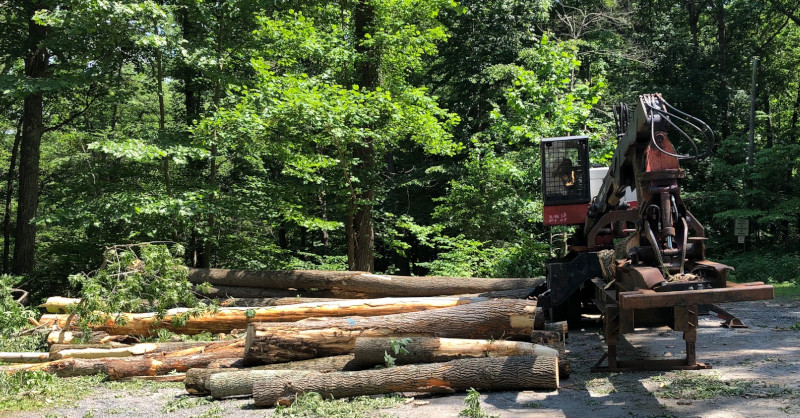
June 2021 logging activity Roaring Rock Park close to Brass Castle Creek
Logging activity
close to Brass Castle Creek

We warned the Township that 10’ wide corridors would have to be cleared to accommodate the “skid steer” machinery used to drag out heavy tree trunks. The weight of the machinery and trees would compact the root systems of the flanking tress, and eventually cause their death. We reminded them that Brass Castle Creek is a Category 1 stream, worthy of the standard DEP 300’ activity-free buffer. It’s also one of only 36 exceptional waterways statewide designated with special regulations as Wild Trout Streams by the DEP Division of Fish & Wildlife, who rated Brass Castle Creek as “excellent” and “optimal” to support the habitat of sensitive species like Brook Trout and Northern Two-lined Salamander, after inspections conducted in 2016 and 2018.

I was shocked to see “Phase I” logging begin on June 21st, the worst possible time of the year because spring and early summer is songbird nesting season. Trees with dozens, if not, hundreds of nests were toppled. It’s also when amphibians, reptiles and sensitive aquatic species emerge. Now, conditions due to logging are horrendous. Multiple haul roads were cut, but no remediation was done to restore muddy road conditions. With heavy summer rain events, mud and silt will run unchecked into Brass Castle Creek. The logger seems to care only about taking marketable logs off site, as all of the tree crowns are piled deeply on site, crushing forest floor habitat. Those piles of drying branches and leaves will add to the forest floor fuel load, compounding the risk of wildfire.

The evidence of critical destruction is apparent on the forest floor. My question to the Washington Township Committee, and indeed, the public who elected them is will you allow this tragedy to continue, or will you do the right thing by promoting reforestation and stopping further logging? What will it be?


John G. Trontis, CPRP
Certified Professional Recreation and Parks

Before his retirement, Trontis was the Assistant Director of the New Jersey DEP Division of Parks and Forestry. Prior to that role, he was Director of Parks and Recreation for Hunterdon County.  Despite being a retired full time public servant, he keeps himself busy as a Trustee of the Warren County Parks Foundation and a District Firewarden for the NJ Forest Fire Service.  He currently resides in Washington Township, Warren County, New Jersey.

BE ADVISED: The NJDEP neither endorses nor opposes the views expressed in this article or the activities of saveroaringrockpark.org in this matter.

Thursday, August 26, 2021

Project outcomes are not always according to plan

tree crowns discarded on RRP forest floor increasing fire load and hazard
Discarded tree crowns which increases fire load
Roaring Rock Park, Warren County, NJ

This is especially true with the Forest Management Plan (FMP) now being executed at Roaring Rock Park, by the Washington Township Warren County NJ municipal government and its logging contractor.

How it started...

If you talk to proponents of forest management, you often hear that managed tree harvesting is a means to reduce the risk of

  1. forest fire hazards, and   
  2. legal liability stemming from potential lawsuits raised by victims harmed by falling dead trees.    

To achieve this goal at Roaring Rock Park, one would think the logging contractor, hired by the municipal government, would need to remove diseased and dead trees from the forest.

How is it going?

The municipal government, through its hired logging contractor, has started to log the park in June 2021, kicking off ten years of tree harvesting.   So will the recent logging activity lead to reduced risks? 

The "reduce forest fire risks" "benefit"

This is a large debate now, as you see forest fires raging in places such as California, Australia and even the Pinelands in southern New Jersey.   You hear that removing trees will reduce the fire load within the forest.

Aside from this ongoing debate, did the outcome of recent logging at Roaring Rock Park, decrease the fire load?

What occurred: the Township's logging contractor cut down mature healthy trees.  As they did this, they lopped off the tree crowns (tree tops) and discarded them on the forest floor.     

As these discarded tree crowns die and rot, they will increase the risk of forest fire by increasing the fire load of the park.   

The "dead trees falling on people" threat

If you observed the tree extraction by the loggers, you will notice that the logs taken were not diseased or dead.   They came from mature healthy trees that were not "ready to fall on residents."


Off to a bad start, let's get back on track

Our group urges Washington Township to:
  1. stop the current logging activity which not only harms the ecology of the park, but runs counter to the benefits its touts, and 
  2. inform the public through regular public meetings that state, on public record, the outcome of recent logging activities and plans for the future phases over the ten year FMP period. 
  3. meet regularly with the New Jersey Highlands Coalition to design a more ecologically responsible FMP that reduces the harm to the forest ecology and wildlife that lives within it.
  4. monitor future logging activity to minimize deviations from the plan.

Tuesday, June 29, 2021

Commercial logging has started at Roaring Rock Park

Commercial logging machinery at Roaring Rock Park


In June 2021, Washington Township started commercial logging at Roaring Rock Park, waving off concerns expressed in the open public meeting on March 16th 2021.   Their decision to proceed runs counter to concerns raised by Warren County Board of Commissions regarding Forest Management Plans, and identified in their resolution adopted May 12th 2021 which opposes state legislation mandating such activity on New Jersey Public Lands.   Similar resolutions identifying the harmful effects of Forest Management has been passed by other local municipalities and counties, namely Hunterdon and Monmouth counties and several local governmental bodies.

If you are concerned about how commercial logging, performed under the context of a "Forest Management Plan",  will impact the park, you can do several things:

  1. if you are a resident, write your elected officials, and express your concerns;
  2. attend the next open public regular meeting, and express your views in person.   They occur the third Tuesdays of each month, and the public is afforded an opportunity to speak out on issues that are on, and not on, the agenda.  If public speaking is not your strong point, consider writing a letter and ask the Town Clerk to enter it into the public record;
  3. show your public support by hosting a lawn sign.

    Do you want to host a lawn sign in your front yard?


    Roaring Rock Park Lawn Sign June 2021

    To show your support publicly, SaveRoaringRockPark.org and its affiliate the New Jersey Highlands Coalition (NJHC), are offering these lawn signs to area residents.   Although not required, donations are greatly appreciated to offset the printing costs.


    Are you interested in hosting one?   If you are...

    THANK YOU !!!


    Here is what you can do to obtain one:
    1. Send an email to lawnsigns@saveroaringrockpark.org to make delivery arrangements.
    2. Please consider donating to help us be successful.  Click HERE to access our donation page. 

    THANK YOU AGAIN FOR HELPING
    SAVE ROARING ROCK PARK !!!

    Commercial logging machinery at Roaring Rock Park
    Commercial logging machinery at Roaring Rock Park

    Wednesday, June 2, 2021

    Washington Borough, Hunterdon County NJ oppose forest management bills

    Shabbacong Creek, Shabbacong Mountain Preserve, Washington Borough, Warren County NJ
    Shabbacong Creek
    downslope from Shabbacong Mountain Preserve

    Washington Borough, Warren County NJ

    On Tuesday June 1st, 2021 the local municipal council of Washington Borough in Warren County and Hunterdon County Board of Commissioners passed resolutions in opposition to three bills (A-4843/S-3549 A-4844/S-3550 A-4845/S-3548) being considered by the New Jersey state legislature.   These two local municipalities' actions followed that of Warren County on May 12th, 2021.

    If passed, these bills would have a devastating effect on New Jersey public lands, for parcels whose size is as small as twenty five (25) acres.   These bills will mandate municipalities to obtain and implement "Forest Management Plans" (FMPs), similar to the one being considered for Roaring Rock Park in Washington Township.  These "plans", despite their benign sounding titles, are primarily commercial logging plans whose primary intent is to transform New Jersey public lands into large scale tree farms, and away from what should be their purpose: to preserve, protect and promote their natural resources and to provide recreational opportunities to residents.  

    For Washington Borough the impact would be realized on the Shabbacong Mountain Preserve, an approximate 80 acre tract of land acquired with Green Acre Funding.   Washington Borough residents, in coordination with the local municipality, have designated this property for recreational use.

    The actions of Washington Borough and Hunterdon County acknowledge:

    1. These bills will essentially create new unfunded mandates, requiring compliance by local government to state law while not providing state funding to local municipalities to facilitate compliance, and remediation of the damage that will result from logging activities;
      1. Adding insult to injury, these bills will prohibit local governments, and their taxpayers, from influencing activities arising from FMPs (the same constituents who would be paying for the implementation!);
      2. These bills will primarily facilitate commercial logging activities, not the retention, protection and promotion of the natural resources (trees, water and wildlife) that reside on New Jersey's public lands (the same resources that make the lands valuable in the first place!)

      Washington Borough and Hunterdon County join a growing list of local municipalities and organizations in opposition to these bills:

      1. Washington Borough, Warren County
      2. Warren County
      3. Hunterdon County    
      4. Monmouth County
      5. Ringwood
      6. West Milford
      7. Raritan
      8. Buena Vista
      9. Clinton
      10. Hardyston
      11. Washington Township, Burlington County
      12. Harding Township 
      13. Rockleigh
      14. Tenafly 
      15. Parsippany – Troy Hills 
      16. South Brunswick 
      17. Lacey Township 
      18. Shamong Township
      19. Princeton
      20. New Jersey League of Municipalities

      We commend Washington Borough Council and the Hunterdon Board of County Commissioners for adopting a well written resolution and proclamation that acknowledge the ecological and recreational value of public lands and forests, and their positive effects on making their communities desirable places to live.   

      Below are images of the adopted Borough resolution and Hunterdon County proclamation. We urge local New Jersey municipalities to consider adopting similar resolutions, especially if they have open public space greater than twenty five (25) acres.


      Sunday, May 16, 2021

      Warren County NJ opposes forest management bills

      Roaring Rock Park Hiking Path Brass Castle Creek Washington Township Warren County NJ
      Roaring Rock Park Hiking Trail
      Brass Castle Creek

      Washington Township, Warren County NJ

      On Wednesday May 12th, 2021 Warren County New Jersey Commissioners unanimously passed a resolution in opposition to three bills (A-4843/S-3549 A-4844/S-3550 A-4845/S-3548) being considered by the New Jersey state legislature.   If passed, these bills would have a devastating effect on New Jersey public lands, for parcels whose size is as small as twenty five (25) acres.   These bills will mandate municipalities to obtain and implement "Forest Management Plans" (FMPs), similar to the one being considered for Roaring Rock Park in Washington Township.  These "plans", despite their benign sounding titles, are primarily commercial logging plans whose primary intent is to transform New Jersey public lands into large scale tree farms, and away from what should be their purpose: to preserve, protect and promote their natural resources and to provide recreational opportunities to residents.  

      The Warren County NJ resolution also acknowledges the short sighted wording of the current bills:

      1. these bills will essentially create new unfunded mandates, requiring compliance by local government to state law while not providing state funding to local municipalities to facilitate compliance, and remediation of the damage that will result from logging activities;
      2. examples of such remediation costs will include, but are not limited to, 
        1. replanting of harvested trees;
        2. removal of silt deposited in waterways, resulting from soil erosion and deposits from commercial logging machinery;
        3. restoration of fish and amphibian populations that will be diminished and killed off by silt pollution of streams and wetlands;
        4. increased control of invasive plant and insect species, both of which will expand their current footholds as the protective tree canopy disappears;
        5. increased control of browsing deer, who will target young tree saplings in a recovering forest for a food source;
        6. destruction of hiking foot paths that may exist on New Jersey public lands if they are to be widened as access roads for commercial logging machinery.
      3. adding insult to injury, these three bills will prohibit local governments, and their taxpayers, from influencing activities arising from FMPs (the same constituents who would be paying for the implementation!);
      4. it acknowledges the bills are primarily focused on commercial logging activities, not the retention, protection and promotion of the natural resources (trees, water and wildlife) that reside on New Jersey's public lands (the same resources that make the lands valuable in the first place!)

      We commend Warren County Commissioners for drafting and passing a well written resolution which acknowledges the ecological and recreational value of public lands and forests, and their positive effects on making Warren County a desirable place to live.    Warren County Commissioners are joining other municipal leaders across this state, such as Albert B. Kelly, mayor of Bridgeton, in recognizing these bills are short sighted and ill designed for New Jersey's municipalities.

      Below is an image of the adopted resolution.   We urge local New Jersey municipalities to consider adopting similar resolutions, especially if they have open public space greater than twenty five (25) acres.


      2021 Warren County NJ Resolution opposing Forest Management Plans Page 1
      2021 Warren County NJ Resolution opposing Forest Management Plans Page 2
      2021 Warren County NJ Resolution opposing Forest Management Plans Page 3
      https://blog.saveroaringrockpark.org/post/651443943653916672/warren-county-commissioners-unanimously-oppose

      Sunday, May 2, 2021

      Legislation threatens New Jersey public forests

      Brass Castle Creek, Roaring Rock Park, Washington Twsp,
          Warren County
      Brass Castle Creek, Roaring Rock Park,
      Washington Township, Warren County, New Jersey

      There are four bills proposed in the New Jersey Legislature (A-4843/S-3549 A-4844/S-3550 A-4845/S-3548 A-4846/S-3547) that would require all publicly owned forested land to be managed under the context of a "Forest Stewardship Plan", likely by a professional forestry logging contractor, in accordance with practices laid out in these four bills. My opinion is that these four bills are ill conceived, but for northern New Jersey there are two that are particularly onerous.

      The two that directly apply to northern New Jersey, A-4843/S-3549 and A-4844/S-3550, pertain to logging plans similar to the one created for Roaring Rock Park in Washington Township, Warren County. One of these bills mandates that all public property purchased with Green Acres funding and having a forested area of 25 acres or more must be subject to a forest stewardship plan. Green Acres open space is managed by state, county and municipal government as well as non-profits, which would all be required to hire foresters to create and carry out logging plans in forested areas.

      The second clause in the second bill (A-4844/S-3550) would prohibit county and municipal governments from passing any ordinances or other rules that would in some way prevent logging of public lands within their jurisdiction, and it would preclude county or municipal approval of forestry plans.   It essentially shuts out local oversight and influence on logging activities on public lands.

      The other two bills (A-4845/S-3548 and A-4846/S-3547) mainly affect the Pinelands in southern New Jersey. A-4845/S-3548 requires a certain amount of acreage in the Pinelands and elsewhere be burned every year and the other, A-4846/S-3547, requires a new government panel to facilitate these logging and burning plans.

      These bills will create these issues:

      1. These bills are primary commercial logging plans, written with the focus and intent to allow widescale tree harvesting with little to no accommodation to the preservation of the natural resources within the public forest land - trees, plants, wildlife and water resources.
      2. These bills make no clear accommodation to remediation of the forest if and when logging activities will cease. The forests will likely be left to recover on their own, since local and county governments will not be afforded funds to provide proactive recovery i.e. widescale tree planting.
      3. A-4843/S-3549 will not require post management restoration requirements to be established. Without these, non-native plant species will have new footholds for invasions. Ruts and overturned soils created by the new access roads and the dragging of heavy mechanized logging equipment across the forest floor, expose forest soils to wind-, animal-, and vehicle-born opportunistic invasive seeds. 
      4. One bill (A-4844/S-3550) will remove local oversight by county and municipal governments, by preventing them from passing local ordinances that would prevent the logging of public lands within their jurisdiction. 
      5. Furthermore, the removal of local oversight will prevent local municipalities, to the extent that they can, from influencing logging activities performed on private held land and under the guide of "forest management plans."   This will complicate the operations of municipal boards such as  Shade Tree Commissions and the ordinances under which they operate.
      6. These current bills amount to unfunded mandates to local and county governments, as it is unclear whether this legislation will provide funding to pay for the logging contractor costs, restoration of the forests after logging ceases, and remediation of environmental issues or damage caused by logging activities to the park itself or adjacent properties that will be left to the local governments to sort out.
      7. It is unclear who will bear the cost burden of remediation of environmental damage that will result from widescale logging, for example, polluted water resources (lakes, rivers).
      8. It is unclear what legal rights adjacent landowners will have to bring lawsuits against the logging contractors, local and state government if their property is damaged by this logging activity.

      If the Forest Management Plan being considered in Roaring Rock Park will be used as a template for all of the public forests within the State of New Jersey, then it is clear the New Jersey Legislature is facilitating the commercial, for profit harvesting of up to 1 million acres of publicly owned forested land. The focus of this plan is treating the public forests more as an expansive tree farm rather than its intended purpose - providing safe recreation experiences for residents and safe habitats for wildlife and native plant species to thrive.

      These bills, if enacted into law, will spell disaster for the continued health and vibrancy of New Jersey's forests. Citizens who use and value these forests - hikers, mountain bikers, fisherman, hunters, Boy and Girl Scouts, bird watchers (to name a few) should be alarmed that the public lands that they pay for maintenance with their tax dollars, will now be exploited by industry with unclear benefits back to the taxpayers (other than decimated public parkland).

      A common rebuttal point you will hear: "these are forests, with living trees, and living trees will grow back." This broad statement glosses over the challenges that will present themselves to forests. Once trees are cleared, more sunlight will enter the park. This will create a situation for the invasive plants to grow more aggressively, and stymie the new tree growth. A cleared forest will make it easier for deer to browse, and tree saplings make for easy food for hungry deer. Taken together, these two points will be significant impediments for a forest to recover.

      Concerned citizens should write their New Jersey Assembly and Senators (in Warren and Hunterdon counties:  Doherty, DiMaio, and Peterson) and ask them to oppose this legislation, for the good of our forests, and to retain them as enjoyable recreational resources for ourselves and for future generations.

      Monday, April 5, 2021

      Brass Castle Creek

      1. a C1 designated Wild Trout Stream;
      2. one of only 41 Wild Trout Stream segments managed by New Jersey Fish & Wildlife;
      3. has naturally reproducing populations of brown trout and brook trout.

      Concerns regarding the commercial logging plan:

      1. how close will logging be to this creek?
      2. will sediment and run off be deposited into the creek?
      3. will logging machinery traverse the creek?
      4. what impact will there be to the naturally reproducing trout in the creek?
      5. what impact will there be to the fishing stock?

      Featured Posts

      Recent Posts

      Our fellow advocacy groups

      Follow us on social media!