Context:
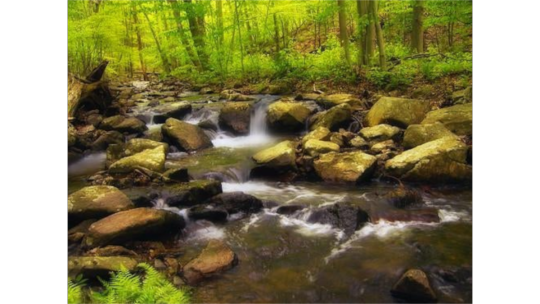
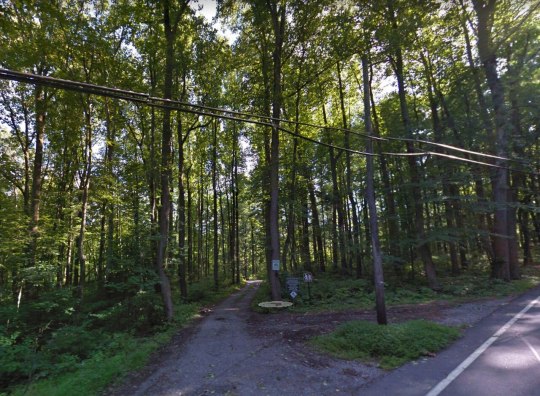
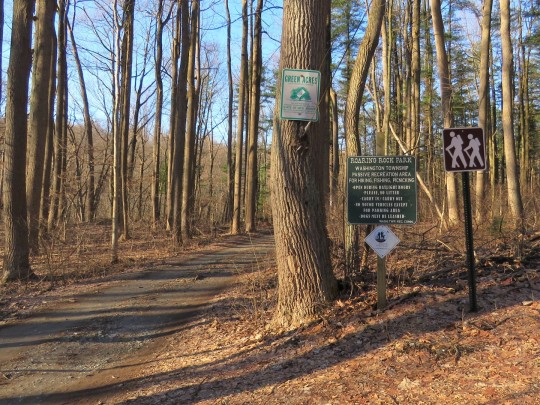
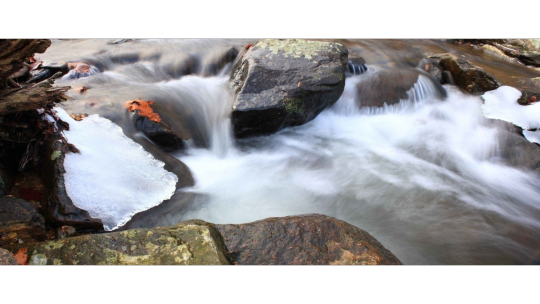
Roaring Rock Park, Washington Township’s beautiful natural public park in Warren County New Jersey, reflects a local story about the loud roar that can be heard as the water of Brass Castle Creek rushes past certain boulders during periods of very high water. The land for this park, which covers a few hundred acres, is set aside for passive use, including hiking and picnicking. Fishing is allowed in the creek, which is stocked with trout.
In 2020, the Township government passed a resolution #2020-110 which called for a “Forest Management Plan” to be developed. The resolution signaled the intent of the Township government to hire a professional logging firm to selectively harvest the trees within the public park over a ten year period. The resolution also indicated the Township would share in the revenue of the timber harvest. Note that this park was acquired by the Township in the 1999 for preservation using New Jersey Green Acre Funding. This is noted on the Township government’s web site.
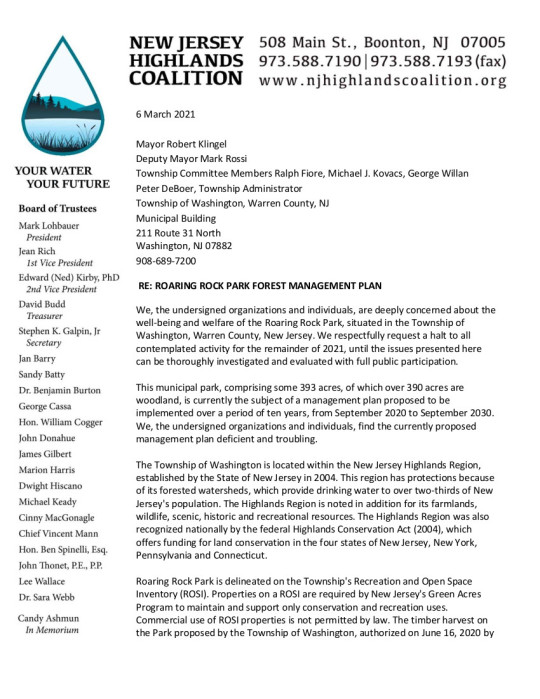
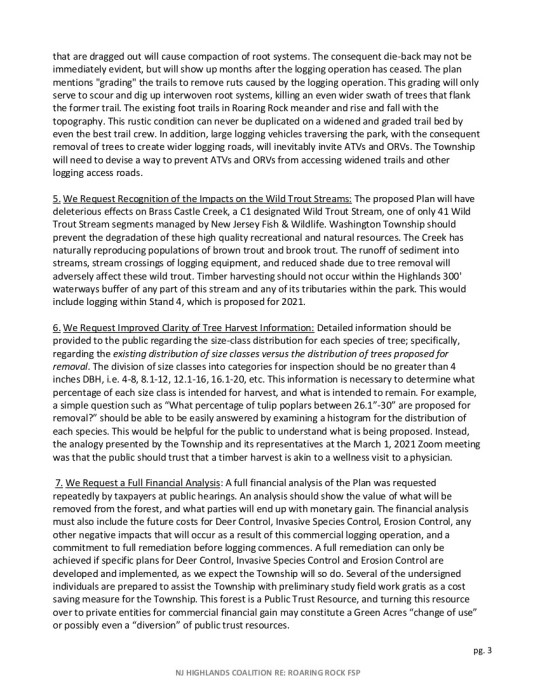
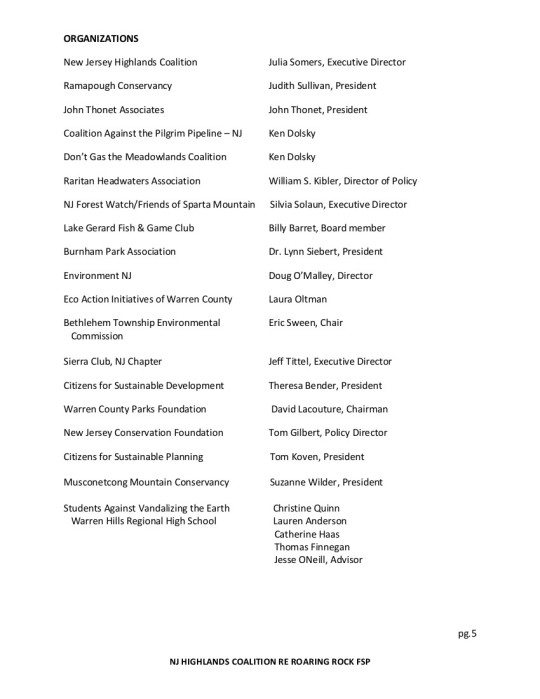
The New Jersey Highlands Coalition reviewed the Forest Management Plan, and has stated their concerns about the environmental impacts to the public forest.
Sara Webb, Ph. D., Professor emeritus of Biology, Drew University, has reviewed the Plan and identified impacts to the ecology of the public forest.

Sara Webb, Ph.D., Forest Ecologist
Professor emeritus of Biology, Drew University
swebb@drew.edu
February 21, 2021
The proposed Forest Management Plan for Roaring Rock Park would damage the region’s quality of life, wildlife, and the environment. The plan provides a comprehensive description of the Park’s forests, but it is a logging-focused plan with negative consequences. It proposes to log 260 acres of forest (40% of a square mile), counting both large timber trees and cords of mid-sized firewood. This plan of action carries costs that might well offset any gains from timber sales. It thus should not be implemented.
The plan does not detail what sort of revenue might be possible, and serious questions must be asked about this, particularly because of expenses that the Township will face after logging: to plant trees, control invasive species, restore trails, and the losses of key ecosystems services.
All should recognize, however, that this plan is a simply a logging plan. Thousands of large trees will be lost. The wood will be hauled away, with its lost value as habitat, carbon sequestration, and soil replenishment. The impacts will be enormous. Damage from logging will be considerable and costly to repair.
Often today such plans are presented as “management” or “stewardship” plans, because as foresters tell me that “logging” sounds so negative. Often these plans assume incorrectly that New Jersey’s forests must be managed to be healthy: to be thinned and cut down for maintenance. We often hear incorrectly that all our trees are the same age, unhealthy, or low in diversity. These assumptions are true at Roaring Rock Park. However, all should recognize that tree harvest and log removal is at the heart of this plan. If our goals were biodiversity and forest health, we should instead manage deer and invasive species, not extract living healthy mature trees.
THIS PLAN IS UNWISE BECAUSE:
- The Plan calls for cutting down large swaths of forest from Roaring Rock Park, clearing 260 acres (40% of a square mile).
- The Plan would cut down 3,500-14,800 trees over the next ten years, some 40% of them very large trees with 60% mid-sized firewood trees.
- The Plan would convert walking trails through the woods into wide logging roadways for logging equipment, cutting into the forest on either side, exposing soil to erosion, especially where the roads are on steep slopes, and to invasive plants. Even if restored sufficiently for use as trails, they will pass through a very changed, cleared landscape which will look very different from the perspective of trail users drawn to using the park.
- Logging management beyond the roads also would increase soil erosion, increase stormwater runoff and flooding, and decrease groundwater recharge. These problems will be even most severe where logging is planned on Roaring Rock’s steep terrain.
- Truck traffic would be heavy on local roads, to transport heavy machinery and logs.
- Water quality is at risk in at least one trout stocked C1 creek: Brass Castle Creek. Water quality in other locations could suffer. Increased runoff would cause more flooding and more seasonal dips in surface and groundwater supplies.
- Habitat and wildlife of natural forests would be greatly harmed, except for deer which would increase. Our region has much open land and plenty of young brushy woods, but little intact mature forest as required by many of our birds, from owls to woodpeckers. Wetlands within the Park are critical habitats also at risk from logging activities. Saying that Best Management Practices will be followed is no guarantee of minimizing damage.
- Invasive species, as the plan explains, are already established at proposed logging areas. They will take over completely wherever the canopy is opened through logging. Roaring Rock would see increased threats from in tree-strangling invasive vines and other invaders that outcompete native wildflowers and young trees. Controlling invasive species is difficult, labor intensive, and often dependent on pesticides. Prevention is best, by maintaining the intact forest canopy cover.
- Logging thus accelerates the steep decline of forest ecosystems by promoting the combination of invasive species and high deer populations.
- With abundant deer and invasive plants, it is very difficult to get forest back after logging. Any natural regeneration is heavily browsed. Planting enough new trees is expensive and they too are devoured by deer. New trees need watering to get established, a logistical challenge on the scale of this logging plan. Ultimately, we must recognize that a future forest simply might not take hold.
Another reason to reject this plan is that climate resilience is greatly harmed when the largest marketable trees are lost. The latest science shows our oldest trees and most intact maturing forests both store and take up the greatest amount of carbon from the air.
COSTS TO THE TOWNSHIP
After logging, there will be major expenses for the Township. We must recognize the limited role of foresters. It is not the role of the Forest Management Plan to take care of or pay for problems that logging will cause; to its credit, this Plan does explain most of the post-logging work that must be done (by others).
It is expensive to replace lost trees and keep the land forested. Even with great effort and investment, it can be impossible to restore forests, because of deer and invasive species. Costs include the purchase and the planting of new trees of sufficient size to survive, the challenge of watering them, and the cost of somehow protecting new trees from deer and invasive plants. Effective deer fencing [10’] and its maintenance as well as herbicides are extremely expensive.
To restore trails from widened logging roadways is also costly and will require extra effort to control invasive plants.
It is also costly and difficult to manage increased storm water runoff, to minimize erosion of bared and disturbed soil, to plan for greater flooding and to grapple with more widely fluctuating water supplies.
The ecologists of the state agree that forest management by logging is not appropriate for northern New Jersey’s natural parks and conservation lands, because of all of these challenges and because intact maturing forests are quite uncommon. Such established forests like those of Roaring Rock provide ecosystem services of many types that should not be squandered lightly. This logging-focused forest management plan is not appropriate.